
Auto Roulette Strategy: RTP Calculator, Fast Betting, Online Roulette Speed, and House Edge Explained
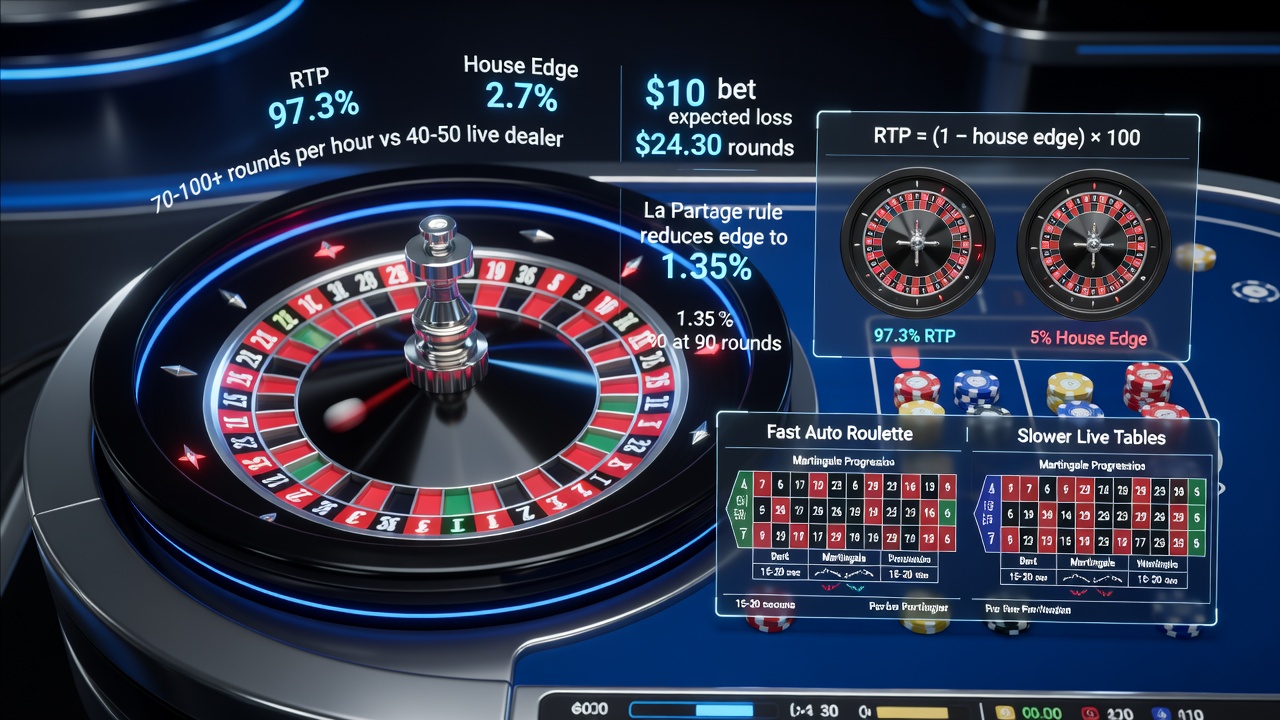
A standard European roulette wheel returns 97.3% of every dollar wagered over the long run, yet most players never check that number before sitting down at an auto roulette table. They watch the ball spin, place a bet within seconds, and repeat the cycle dozens of times per hour without ever asking what the math behind the wheel actually guarantees. That gap between speed and awareness is exactly where auto roulette becomes either a disciplined pastime or an expensive habit.
Auto roulette strips away the human dealer and replaces manual pacing with a mechanized wheel that spins on a fixed schedule, often completing a round every 20 to 30 seconds. That pace rewards players who understand bankroll math and punishes those who don't. Before chasing faster action, it helps to see how the format compares to live tables - you can visit site to see a real example of a speed-focused auto roulette game and get a feel for the pacing firsthand. The rest of this piece breaks down the RTP calculations, betting mechanics, and house edge figures that determine whether that pace works for or against you.
What follows is a practical breakdown built for players who want numbers, not superstition. We'll cover how to calculate expected returns, how betting speed changes your effective loss rate per hour, and which auto roulette variants offer the most favorable structure for disciplined play.
What Is Auto Roulette and Why Speed Changes the Game
Auto roulette uses a mechanical or electromechanical wheel governed by a random number generator or physical sensor system, with no human croupier calling bets or spinning the wheel manually. The absence of a dealer removes the natural pauses that occur at live tables - no chip counting, no small talk, no manual ball placement. Rounds proceed on a timer, and that timer is the single biggest factor separating auto roulette from its traditional counterpart.
How Auto Roulette Differs From Live Dealer Roulette
Live dealer roulette typically runs 40 to 50 rounds per hour because a person physically spins the wheel, releases the ball, and processes payouts between rounds. Auto roulette compresses that cycle significantly, often reaching 70 to 100+ rounds per hour depending on the platform. The wheel itself doesn't behave differently - the physics of a fair roulette wheel are identical whether a person or a machine spins it - but the frequency of decisions changes dramatically.
The Mechanics Behind Automated Wheel Spins
Most auto roulette systems use optical sensors or RFID tracking to detect the ball's landing position instantly, eliminating the delay a human dealer needs to visually confirm and announce a result. This mechanical precision means results are recorded and paid out within seconds of the ball settling, which is the core driver behind online roulette speed. Betting windows are also standardized and often shorter than live tables, typically 15 to 20 seconds instead of 25 to 30.
Why This Format Appeals to High-Volume Players
Players who want maximum rounds per session gravitate toward auto roulette because it removes downtime. For someone testing a betting progression or tracking outcomes across many spins, the compressed format delivers more data points per hour than any other roulette variant.
- Auto roulette: 70-100+ rounds per hour
- Live dealer roulette: 40-50 rounds per hour
- Multi-wheel or speed variants: can exceed 100 rounds per hour
Understanding the Roulette RTP Calculator
Return to Player, or RTP, expresses the percentage of total wagers a game is mathematically expected to return to players over a large number of rounds. It's the inverse of the house edge, and understanding how to calculate it turns roulette from a game of pure guesswork into one with predictable long-term expectations, even though individual sessions remain unpredictable by nature.
How RTP Is Calculated for Roulette Variants
The formula is straightforward: RTP = (1 − house edge) × 100. For European roulette with a single zero, the house edge sits at 2.7%, producing an RTP of 97.3%. American roulette, with its additional double-zero pocket, carries a 5.26% house edge and correspondingly lower RTP of 94.74%. A roulette RTP calculator simply automates this formula while letting you adjust for specific bet types, since some bets - like the five-number bet in American roulette - carry a worse edge than the table average.
Using an RTP Calculator to Compare Bet Types
Not every bet on the table shares the same edge. Straight-up bets, split bets, and outside bets like red/black or odd/even all pay according to true odds relative to 37 or 38 possible outcomes, but the house edge stays mathematically constant across almost all bet types on a standard wheel. The exception is the aforementioned five-number bet in American roulette, which pushes the house edge up to 7.89%. Running these figures through an RTP calculator before choosing a bet type prevents costly mistakes.
Why RTP Figures Matter More in Fast-Paced Formats
A 2.7% house edge sounds negligible on a single spin, but it compounds with volume. At 40 rounds per hour, that edge erodes your bankroll gradually. At 90 rounds per hour, the same edge works twice as fast in absolute terms simply because more wagers pass through the wheel. This is precisely why RTP awareness becomes more, not less, important as game speed increases.
Fast Roulette Betting: Mechanics and Realistic Expectations
Fast roulette betting refers to the shortened betting windows and rapid round turnover characteristic of auto and speed roulette formats. It's not a separate game - it's a pacing structure layered onto standard roulette rules, and it changes how players need to approach both strategy and bankroll management.
How Betting Windows Work in Speed Formats
Speed and auto roulette tables typically give players 15 to 20 seconds to place or adjust bets before the wheel spins automatically. This is roughly half the time allotted at a standard live table. Players relying on complex betting layouts covering ten or more numbers may find the window too short for careful placement, which increases the risk of misclicks or rushed decisions.
Adapting Betting Systems to Faster Rounds
Progressive betting systems like Martingale or Fibonacci require quick mental math between rounds - you need to know your next stake before the timer runs out. Fast roulette betting formats demand that this calculation happen almost instantly, which is why experienced players often pre-plan their progression table rather than calculating on the fly.
The Real Cost of Speed: Hourly Loss Rate
The single most overlooked consequence of fast betting is how it multiplies expected hourly loss. A player wagering $10 per spin at a 2.7% house edge loses an expected $0.27 per round. At 45 rounds per hour, that's roughly $12.15 in expected losses. At 90 rounds per hour, it doubles to roughly $24.30, even though nothing about the bet or the odds changed. Speed itself becomes a financial variable.
- $10 bet, 2.7% edge, 45 rounds/hour ≈ $12.15 expected loss
- $10 bet, 2.7% edge, 90 rounds/hour ≈ $24.30 expected loss
- $10 bet, 5.26% edge (American), 90 rounds/hour ≈ $47.34 expected loss
Online Roulette Speed: How It Affects Bankroll and Decision-Making
Speed changes more than math - it changes psychology. When rounds arrive every 15 seconds instead of every 90, players have less time to reflect on losses, adjust strategy thoughtfully, or recognize when a session has gone off track.
Cognitive Load in High-Speed Roulette Sessions
Decision fatigue sets in faster during high-frequency play. Studies on rapid-cycle gambling formats consistently show that reduced time between decisions correlates with less deliberate choice-making and a higher likelihood of chasing losses. Auto roulette's compressed pacing places players squarely in this higher-risk decision environment.
Setting Time-Based and Loss-Based Limits
Because online roulette speed multiplies the rate at which a bankroll can be depleted, session limits work better when set by round count or elapsed time rather than by "feel." A player who decides in advance to stop after 100 rounds or 30 minutes protects themselves from the momentum effect that fast tables create.
Balancing Speed With Strategic Control
Faster isn't automatically worse - it simply requires tighter discipline. Players who bring a pre-calculated auto roulette strategy to the table, including fixed bet sizes and stop-loss thresholds, neutralize much of the risk that speed introduces. The strategy has to exist before the session starts, because there's no time to build one mid-game.
Roulette House Edge Explained: The Numbers Behind Every Spin
The house edge is the built-in mathematical advantage that guarantees the casino profits over a large enough sample of bets, regardless of any individual outcome. It's fixed by the wheel's structure, not by dealer behavior, software tricks, or player skill.
Single-Zero vs. Double-Zero Wheels
European roulette's single zero produces a 2.7% house edge. American roulette's extra double-zero pocket nearly doubles that figure to 5.26%. This distinction alone should guide table selection - choosing a European wheel over an American one is the single easiest way to improve long-term expected outcomes without changing any betting behavior.
How La Partage and En Prison Rules Lower the Edge Further
Some European tables apply La Partage or En Prison rules to even-money bets (red/black, odd/even, high/low), returning half the stake or "imprisoning" it for another spin when the ball lands on zero. These rules cut the effective house edge on even-money bets to roughly 1.35%, making them the most favorable wagers available on a roulette table.
Why the House Edge Never Changes With Bet Size or Speed
A common misconception holds that betting larger or smaller amounts, or playing faster or slower, alters the house edge. It doesn't. The edge is a percentage baked into the payout structure relative to true odds. What changes with speed and bet size is total exposure - how much of your bankroll passes through that fixed edge per hour.
Building a Practical Auto Roulette Strategy
A workable auto roulette strategy doesn't try to beat the house edge - that's mathematically impossible over time. Instead, it manages exposure, controls pacing, and uses RTP data to select the most favorable bets and tables available.
Choosing the Right Wheel and Bet Combination
Start with a European single-zero wheel whenever available, and favor even-money outside bets if La Partage or En Prison rules apply. This combination offers the lowest realistic house edge you'll find on any roulette variant, auto or otherwise.
Setting Fixed Bet Sizing Before You Sit Down
Given how quickly fast roulette betting cycles through rounds, decide your flat bet size or progression schedule before the session begins. Avoid recalculating mid-session; the shortened betting window doesn't leave room for careful arithmetic under pressure.
Using Session Limits to Offset Round Speed
Because online roulette speed accelerates bankroll turnover, set a hard round-count or time limit rather than a vague "I'll know when to stop" mentality. A 30-minute or 100-round cap keeps expected losses within a predictable, budgeted range.
Tracking Results Against RTP Expectations
Keep a simple log of wins, losses, and rounds played, then compare your actual results against the theoretical RTP for your chosen bet type. Significant deviation over a large sample is normal in the short term - variance is real - but the log keeps expectations grounded in math rather than emotion.
Frequently Asked Questions
Is auto roulette rigged to pay out less than live roulette?
No. Auto roulette uses the same physical wheel structure and odds as live roulette; the house edge comes from the zero pocket(s), not the automation. Reputable platforms use certified random number generation or sensor-based tracking that produces the same statistical outcomes as a human-operated wheel.
Does playing faster increase my chances of losing?
Playing faster doesn't change your odds on any single spin, but it increases the total number of bets placed per hour, which multiplies your expected loss in absolute dollar terms. The house edge percentage stays the same regardless of speed.
Which roulette bets have the lowest house edge?
Even-money outside bets - red/black, odd/even, high/low - on a European wheel with La Partage or En Prison rules carry the lowest house edge, around 1.35%. Without those rules, the standard European house edge across nearly all bet types is 2.7%.
Can an RTP calculator actually help me win more?
An RTP calculator won't increase your odds of winning any given spin, but it helps you identify which bets and wheel types minimize expected losses over time. It's a planning tool for bankroll management, not a prediction tool.
How many rounds per hour should I expect on auto roulette?
Most auto roulette tables run between 70 and 100+ rounds per hour, roughly double the pace of a standard live dealer table. Some speed-specific variants can exceed this range depending on the platform's betting window length.
Is American roulette ever a better choice than European?
Rarely. The added double-zero pocket in American roulette nearly doubles the house edge to 5.26% compared to European roulette's 2.7%. Unless a specific promotion or bonus structure specifically favors the American wheel, European roulette is mathematically superior for players.