
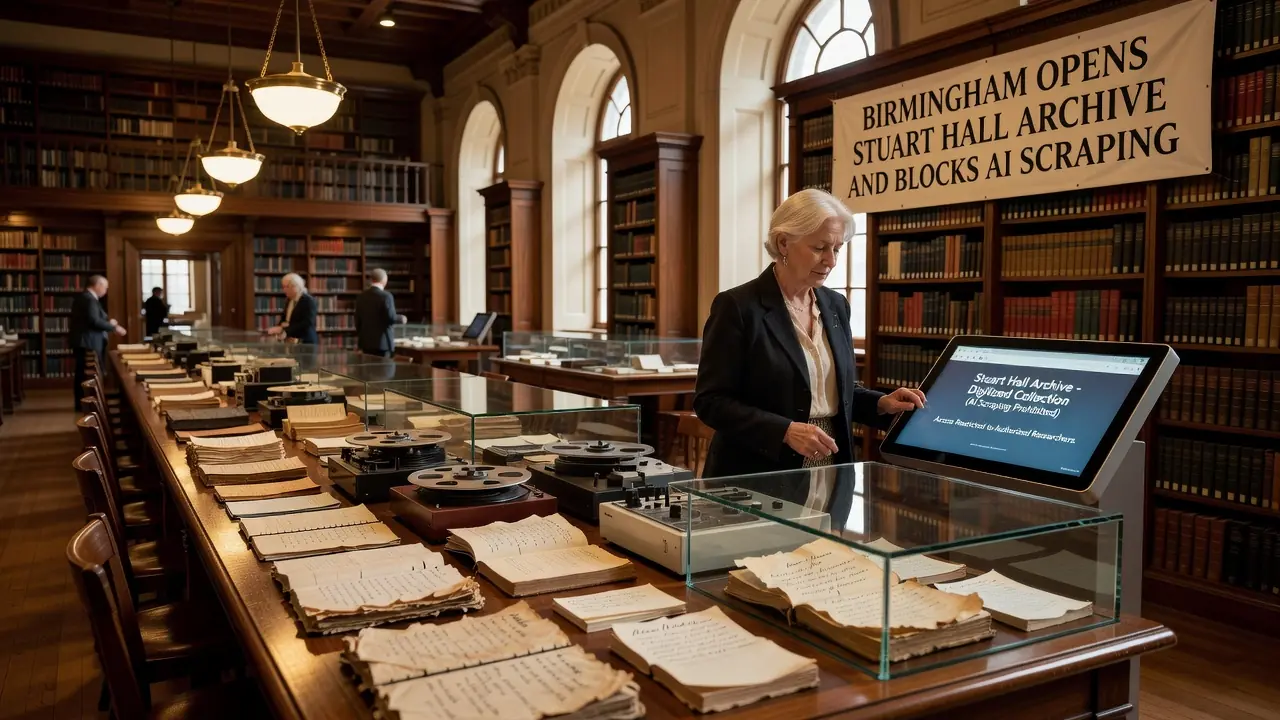
More than 3,100 items from the private papers of Stuart Hall have gone online, giving the public its first full view of notebooks, lecture recordings, index cards and an abandoned doctoral thesis belonging to one of postwar Britain's most influential thinkers. The University of Birmingham, where Hall built the Centre for Contemporary Cultural Studies, digitised the material after it was donated by his widow, the historian Catherine Hall. Crucially, the team behind the project has taken a deliberate technical stance against artificial intelligence companies harvesting the archive for training data.
A thinker who named his moment
Hall, who died in 2014, is remembered for coining "Thatcherism" and for warning in 1985 about "authoritarian populism" - a phrase that reads as freshly relevant now as it did then. Born in Jamaica, he arrived in Britain in 1951 on a Rhodes scholarship, edited the founding issues of New Left Review, taught in Brixton schools, and eventually built an academic department in Birmingham that became a meeting point for debates on race, media and power. His theory of representation, which examined how meaning is constructed through language and cultural codes, gave later generations a framework for scrutinising everything from news coverage to algorithmic systems.
Why the archive refuses AI access
The decision to block bots is the most consequential part of this launch, and it speaks directly to current tensions around data ownership, copyright and corporate power in the AI economy. The Cadbury Research Library, which catalogued Hall's original papers, has run the digital collection through software designed to "poison" the data against automated scraping. Project lead Dr Rebecca Roach, working alongside Helen Fisher and Dr Katherine Parson, said the archive was not built "just for AI to scrape" and commercialise without consent or compensation. That framing matters: large language models are typically trained on vast troves of text and media gathered without direct permission from rights holders, a practice now under legal and regulatory challenge across multiple jurisdictions.
Roach has connected this decision explicitly to Hall's own ideas, arguing the archive should not "replicate the exploitation of people of colour and their cultural heritage that technology has historically enabled." The point is not abstract. Cultural institutions, publishers and individual creators are grappling with the same question: whether digitisation for public access can be separated from exposure to commercial AI training pipelines. Birmingham's answer - build the resource, but technically fence it off - is one model other archives may watch closely as they weigh openness against control.
From the Walkman to machine learning
The archive also includes Encoding/Decoding Cybernetics, a research strand examining Hall's influence on the architecture of large language models, and his "Origins of the new left" lecture alongside notebooks on race and moral panics. Hall's co-authored textbook Doing Cultural Studies used the Sony Walkman as a case study in how a single piece of technology carries social, cultural and economic meaning simultaneously. That same method - reading technology as a cultural object rather than a neutral tool - is precisely what the archive's custodians are now applying to AI itself, treating machine learning systems as sites where questions of bias, representation and ownership play out in real time.
Wider public engagement
The project extends beyond the archive database. Roach has produced learning materials for primary schoolchildren, the art collective Vivid Projects has created a zine called Dear Stuart, and university students have built Walking with Hall, a virtual campus tour that considers what it meant for Hall to work in the shadow of Joseph Chamberlain, the university's imperialist founder. Prof Daniel McNeil, who holds the Stuart Hall interdisciplinary chair at Birmingham, called the collection "an extraordinary resource," noting that Hall "transformed how we think about culture, identity, power and belonging." The archive stands, then, not only as a historical record but as a working argument about how institutions should handle cultural heritage in an age of automated extraction.