
Legal Online Casinos in the U.S.: Why Real Money iGaming Remains a State-by-State Market in 2026
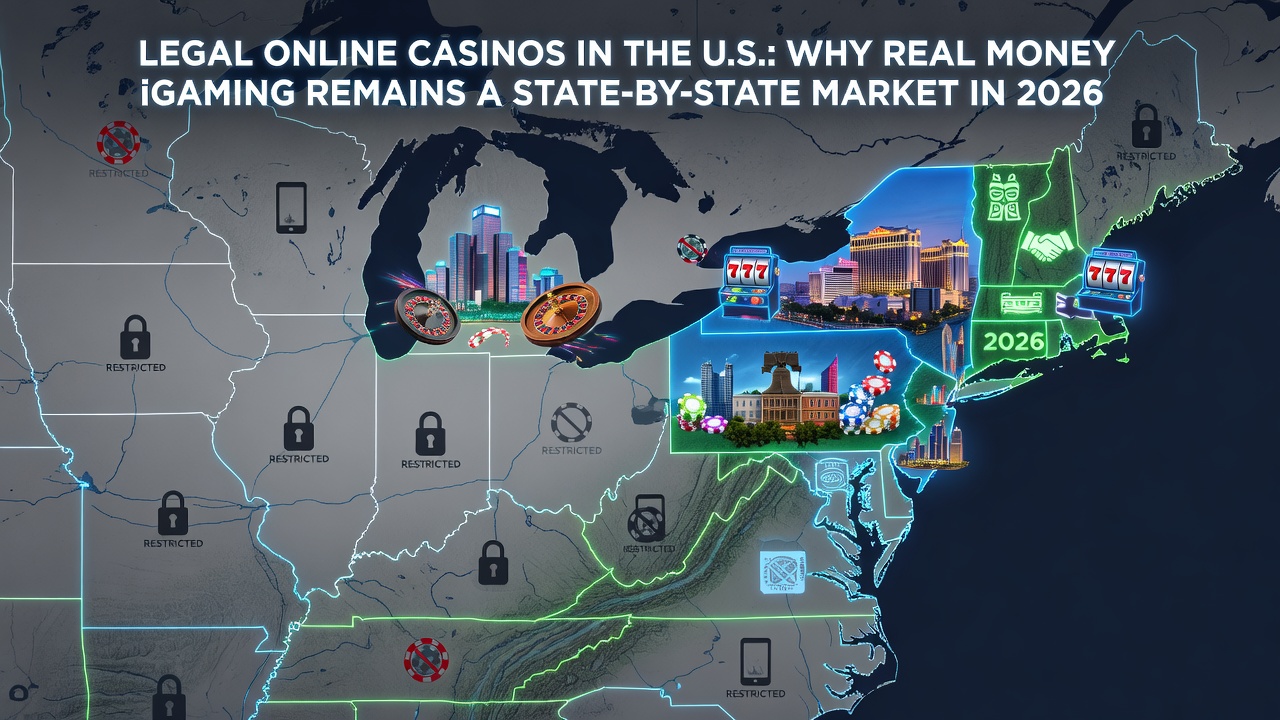
Seven states currently allow real money online casino play. Fifty states allow sports betting in some form. That gap is not an accident, and it will not close anytime soon. Anyone expecting a federal green light for internet casinos in the near future is misreading how gambling law actually works in this country, and misreading it badly.
Legal online casinos in the U.S. operate under a patchwork that dates back to a foundational choice made decades ago: gambling regulation belongs to the states, not to Washington. That single fact explains almost everything confusing about the current landscape - why a player in New Jersey can spin a slot machine from their couch while a player forty miles away in Pennsylvania has a different app with a different game library, and why someone in Texas has no legal option at all. Even the mechanics of cashing out vary by operator and jurisdiction, which is why players often search for basic guidance like how can i withdraw casino winnings before they ever place a bet - the answer depends entirely on which state's licensed platform they're using.
This piece breaks down why real money iGaming laws in the USA remain fragmented, which states have moved forward, which are stalled, and what the practical implications are for players trying to figure out where they legally stand in 2026.
The Legal Foundation: Why Gambling Law Is a State Matter
Gambling regulation in the United States traces back to the Tenth Amendment's reservation of powers to the states. Unlike banking or securities law, where federal agencies set baseline rules nationwide, gambling has never had a comprehensive federal regulatory body. Congress has intervened selectively - banning certain payment processing methods, restricting interstate wire transmission of bets - but it has never claimed authority to legalize or license casino games directly.
The Wire Act and Its Lingering Shadow
The Wire Act of 1961 was written for a pre-internet world, targeting telephone-based sports betting operations tied to organized crime. Its exact scope regarding online casino games versus sports wagering has been the subject of conflicting Department of Justice opinions and federal court rulings over the past decade. That ambiguity still makes some state legislators cautious, even though courts have generally sided with an interpretation limiting the Wire Act to sports betting.
UIGEA and Payment Processing
The Unlawful Internet Gambling Enforcement Act of 2006 didn't outlaw online gambling itself. It targeted the flow of money to unlicensed operators, forcing banks and payment processors to block transactions tied to illegal gambling sites. This indirectly pushed the market toward a licensed, state-regulated model - if a state legalizes and licenses an operator, banks can process those payments without legal exposure.
Why No Federal Framework Has Emerged
Multiple federal bills addressing online gambling have been introduced over the years; none have passed. Tribal gaming interests, land-based casino operators, and state governments protecting their own tax revenue streams all have reasons to prefer state control over federal preemption. This alignment of interests, rather than any technical obstacle, is the real reason online casino legality by state remains the operating model.
The Current Map: Which States Allow Real Money Online Casinos
As of 2026, the roster of states with fully licensed, regulated real money online casino platforms remains small relative to the total number of states. New Jersey, Pennsylvania, Michigan, Connecticut, West Virginia, Delaware, and Rhode Island form the core of the legal iGaming market. Each launched its program through separate legislation, on its own timeline, with its own tax rate and licensing structure.
The First Movers
New Jersey legalized online casino gaming in 2013, becoming the proving ground for the entire industry. Delaware moved at nearly the same time through its lottery-run model. These early adopters shaped how later states approached licensing, tax rates, and consumer protection standards.
The Second Wave
Pennsylvania and Michigan followed with larger populations and correspondingly larger revenue potential, drawing major national operators into the state-by-state iGaming regulation system. West Virginia and Connecticut added smaller but functioning markets, proving the model scales down as well as up.
States Actively Debating Legalization
New York, Illinois, and Indiana have all seen legislative proposals for online casino expansion, often tied to budget negotiations. Land-based casino lobbying, concerns about cannibalizing retail gaming revenue, and disagreements over tax rates have repeatedly stalled these efforts.
- New Jersey - legal since 2013, largest and most mature market
- Pennsylvania - legal since 2017, strong operator competition
- Michigan - legal since 2021, rapid revenue growth
- Connecticut - legal since 2021, tribal partnership model
- West Virginia - legal since 2020, smaller but stable
- Delaware - legal since 2013, lottery-operated system
- Rhode Island - legal since 2023, newest entrant
Why Some States Refuse to Legalize
Understanding state by state igaming regulation requires understanding resistance, not just adoption. Several structural and political factors keep large states out of the market entirely.
Land-Based Casino and Tribal Opposition
In states where physical casinos generate substantial employment and tax revenue, operators often lobby against online casino legalization, fearing it will divert foot traffic and spending from brick-and-mortar properties. Tribal gaming compacts add another layer of complexity, since many tribes hold exclusive gaming rights negotiated decades ago that don't clearly account for internet-based products.
Social and Moral Concerns
Some legislatures remain wary of expanding access to gambling, particularly given concerns about problem gambling rates rising when games move from a physical location to a phone in someone's pocket at any hour. This isn't a fringe argument - it shapes real votes in state capitols.
Revenue Sharing Disputes
Even when there's political appetite for legalization, disagreements over how tax revenue gets split between the state, operators, and existing casino license holders can stall bills for years. Illinois has seen this dynamic play out repeatedly, with proposals introduced and then shelved.
How State-by-State Regulation Affects Players
For the average player, this fragmented system creates real consequences that go beyond legal trivia.
Geolocation Enforcement
Licensed operators use geolocation technology to verify a player's physical location in real time, not just their billing address. Cross a state line mid-session, and the app will lock you out. This isn't a bug - it's a core compliance requirement tied directly to real money igaming laws in the USA.
Account Portability Doesn't Exist
A player with an account and deposited funds in New Jersey cannot use that same account to play in Pennsylvania. Each state requires separate registration, separate identity verification, and often a separate deposit, because each operates under a distinct license.
Bonus Structures and Promotions Vary
Welcome bonuses, loyalty programs, and promotional structures differ by state due to differing regulatory caps on advertising and incentive structures. What's offered in Michigan may not be legally permissible in Connecticut.
What Might Change the Landscape by 2027 and Beyond
The pace of expansion has been slower than early industry predictions suggested, but momentum hasn't disappeared entirely.
Sports Betting as a Precedent
The rapid spread of legal sports betting after the 2018 Supreme Court decision in Murphy v. NCAA demonstrated that states move quickly once the financial case becomes undeniable. Online casino legality by state may follow a similar, if slower, trajectory as states watch their neighbors collect tax revenue they're currently leaving on the table.
Budget Pressure as a Catalyst
States facing budget shortfalls have historically turned to gambling expansion as a revenue lever. Online casino gaming, with its comparatively low infrastructure cost versus new brick-and-mortar licensing, is an attractive option when legislators need new income streams without raising broad-based taxes.
Continued Fragmentation Is the Likely Default
Barring a major shift in federal policy - which remains unlikely given the entrenched state interests described earlier - the realistic expectation is incremental, state-by-state growth rather than any unified national framework.
Frequently Asked Questions
Can I play at legal online casinos if I'm traveling through a state that allows it?
Yes, as long as you're physically present within the state's borders when you place a wager, even temporarily. Geolocation software confirms your location continuously during play, so the moment you leave the state, access is cut off regardless of where your account was originally registered.
Why does Pennsylvania have different games than New Jersey?
Each state's gaming commission approves games and operator licenses independently, and operators choose which titles to offer based on licensing costs, local demand, and contractual arrangements with software providers. There's no requirement for consistency across state lines.
Is offshore online gambling a legal alternative in states without regulated casinos?
No. Offshore sites operating without a U.S. state license are not legally sanctioned, offer no consumer protection guarantees, and using them carries financial and legal risk. Players in unregulated states currently have no fully legal real money online casino option available to them.
Will federal legislation ever standardize online casino laws nationwide?
It's unlikely in the near term. The combination of tribal gaming interests, state revenue protection, and land-based casino lobbying creates strong incentives to keep regulation at the state level, and no major federal bill addressing this has gained meaningful traction in Congress.
How do I know if an online casino is legally licensed in my state?
Check your state's official gaming or lottery commission website, which publishes a list of licensed operators. Legitimate licensed sites also display their license number and regulatory body, typically in the footer of their website.
Does playing at a licensed online casino affect how I withdraw winnings?
Withdrawal processes are set by each operator and vary by state regulation, covering verification requirements, processing times, and available payout methods. It's worth reviewing the specific withdrawal policy for your platform before depositing, since requirements can differ meaningfully between operators.