
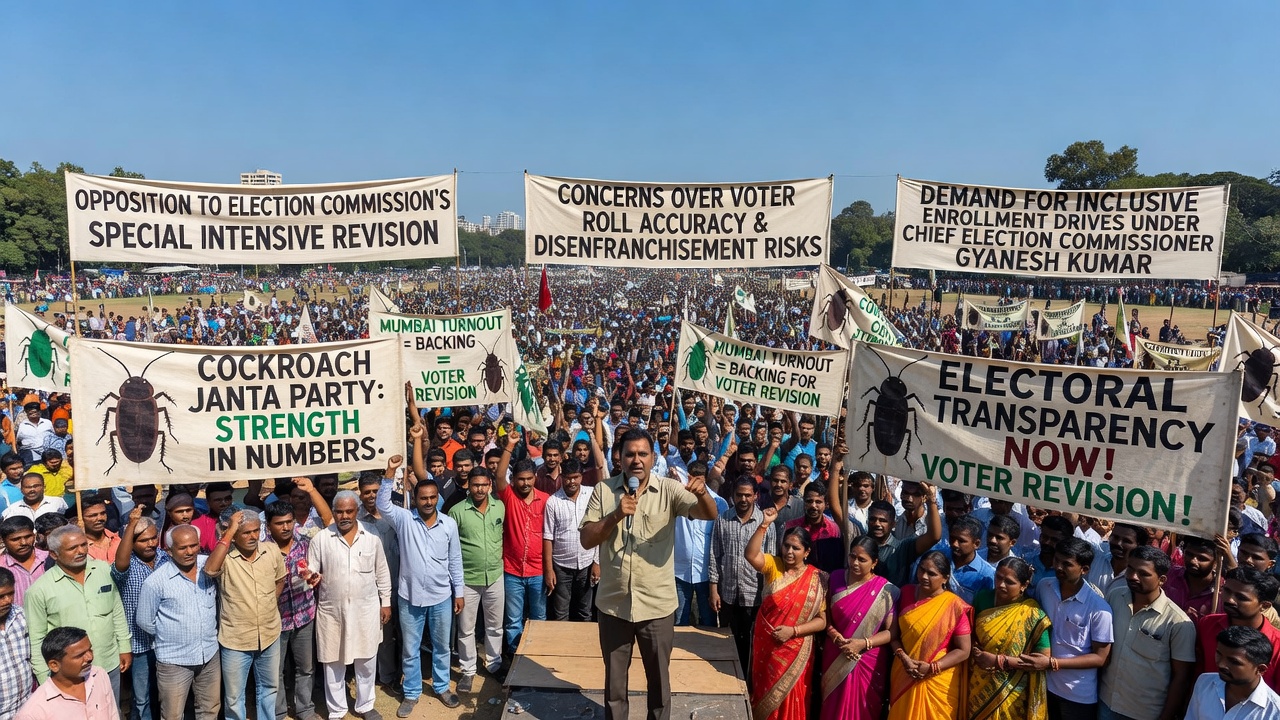
A political theatre group turned registered outfit has inserted itself into a nationwide argument over how India verifies its voter rolls. Saurav Das, spokesperson for the Cockroach Janta Party, told India Today that the group's protest at Shivaji Park in Mumbai drew a crowd large enough to call the venue "full" and "overflowing," which he presented as evidence of public unease with the Election Commission's Special Intensive Revision process under Chief Election Commissioner Gyanesh Kumar.
What the Special Intensive Revision Dispute Is Actually About
The SIR exercise is the Election Commission's mechanism for cleaning and updating electoral rolls, a process that periodically triggers friction because it can add or remove names depending on documentation and verification outcomes. Critics argue that intensive revisions, if poorly communicated or rushed, risk disenfranchising eligible voters who lack easy access to paperwork. The Commission's own response - a special voter enrolment drive announced alongside the protests - suggests an attempt to address gaps in registration even as it defends the broader revision process. This tension between administrative tidiness and inclusion is not new to Indian electoral management, but it resurfaces whenever a revision cycle coincides with heightened political scrutiny.
A Small Party, a Bigger Platform
Das used the Mumbai turnout to announce an expanding itinerary - protests planned in Karnataka, Uttar Pradesh and West Bengal before the group returns to Delhi. Whatever one makes of the Cockroach Janta Party's satirical branding, its strategy here is conventional: convert a single well-attended event into momentum for a multi-state campaign, using media coverage to amplify a message beyond what its formal organisational size would otherwise achieve. This is a familiar pattern for fringe and protest-oriented political formations, which often rely on visibility rather than electoral infrastructure to stay relevant between polls.
Contested Space for Dissent
Das also criticised restrictions on protest venues, a complaint that sits alongside the starker contrast from Delhi, where similar demonstrations reportedly resulted in more than a thousand detentions. The gap between a permitted, well-attended gathering in Mumbai and mass detentions in the capital highlights how enforcement of protest rights can vary sharply by city and by the discretion exercised by local authorities. For a debate centred on voter access and electoral transparency, the handling of dissent itself becomes part of the story - raising questions about proportionality and consistency in how authorities manage public assembly around election administration issues.
Why the Voter Rolls Debate Matters Beyond Mumbai
Electoral roll accuracy affects the legitimacy of every subsequent vote count, which is why revision processes attract disproportionate attention relative to their bureaucratic nature. The Election Commission's enrolment drive signals recognition that the SIR process needs complementary outreach, not just verification. Whether the protests meaningfully shift that process, or simply add to the political noise around it, will depend less on crowd size at any single rally and more on whether the Commission adjusts its procedures in response to documented access barriers.