
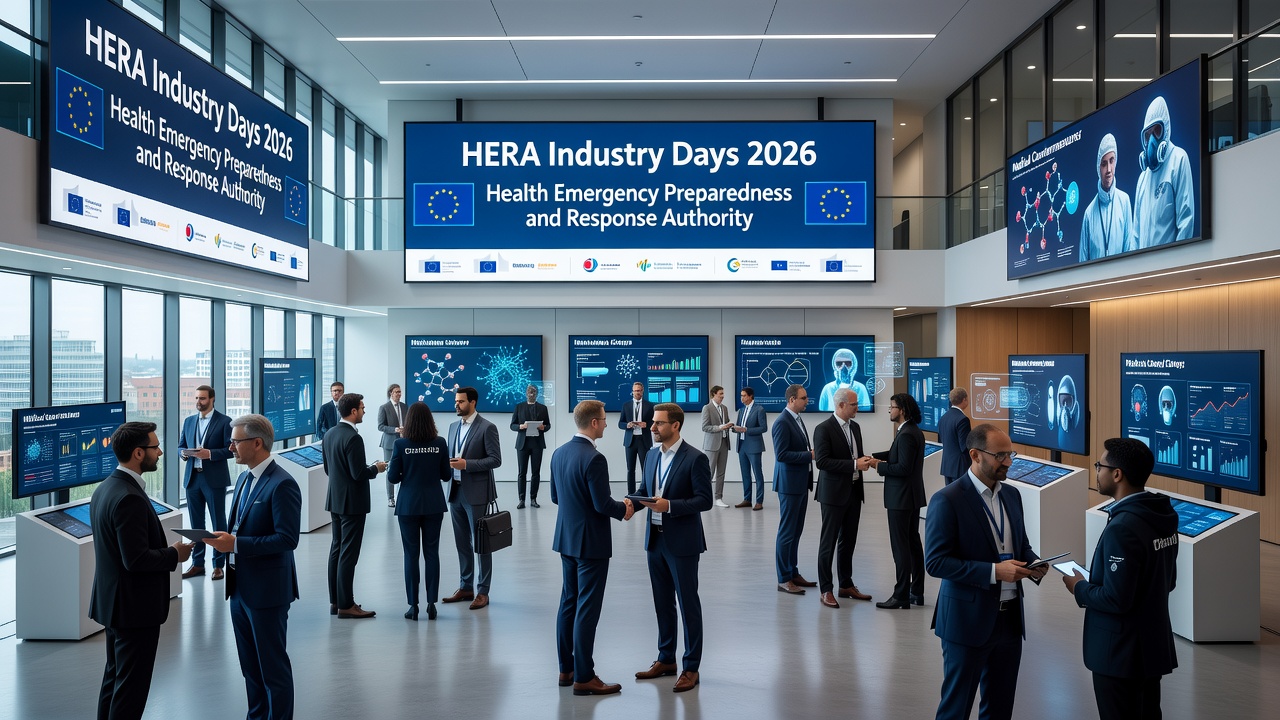
Europe's health security architecture faces a recurring test: how to move from policy ambition to operational readiness before, not during, a crisis. HERA Industry Days 2026 is positioned to address exactly that gap, bringing together industry leaders, EU institutions, researchers, innovators, start-ups and public authorities working on medical countermeasures. As the flagship annual event of the Health Emergency Preparedness and Response Authority, it functions as a structured meeting point rather than a conference in the conventional sense.
Why a dedicated forum matters
Medical countermeasures - vaccines, therapeutics, diagnostics, protective equipment - depend on supply chains and manufacturing capacity that are rarely built with emergencies in mind. Commercial incentives for stockpiling rare-use products are weak, and public funding mechanisms often move slower than outbreaks. HERA was created to close that mismatch by acting as a bridge between public health authorities and the companies, researchers and start-ups capable of delivering countermeasures at scale. An event of this kind gives those actors a shared space to align priorities, rather than negotiating separately through fragmented procurement channels.
What the agenda signals about EU priorities
The stated themes - health preparedness, funding opportunities, public-private cooperation and future security priorities - reflect a broader shift in how Brussels treats health as a strategic, not purely clinical, domain. Framing pandemic response alongside industrial policy and funding architecture suggests the EU wants preparedness embedded in long-term market structures, not just emergency budgets activated after the fact. For biotech and medtech firms, this matters commercially: visibility into HERA's funding priorities can shape where companies direct research and manufacturing investment well before any crisis materialises.
Networking as policy infrastructure
The networking component is not incidental. Public-private cooperation in health security has historically suffered from poor information flow - authorities unaware of emerging technologies, and innovators unaware of procurement timelines or regulatory expectations. Structured interaction between regulators, researchers and start-ups is designed to shorten that distance, helping smaller innovators understand how to engage with EU mechanisms that are otherwise difficult to navigate from outside.
Implications beyond the event itself
Gatherings of this type carry weight disproportionate to their duration because they shape expectations for subsequent funding calls, partnership frameworks and regulatory guidance. For start-ups in particular, participation can be a practical entry point into EU-level health security planning, an area where credibility and early relationships with institutional actors often matter as much as technical capability. For established industry players, it offers a formal channel to flag bottlenecks - manufacturing, regulatory approval speed, cross-border logistics - that affect how quickly countermeasures can reach the field when needed.
- Organised by DG HERA as its principal annual stakeholder event
- Brings together EU institutions, industry, researchers, start-ups and public authorities
- Focus areas include preparedness, funding, public-private cooperation and security priorities
- Includes structured networking across healthcare, biotech and medtech sectors