
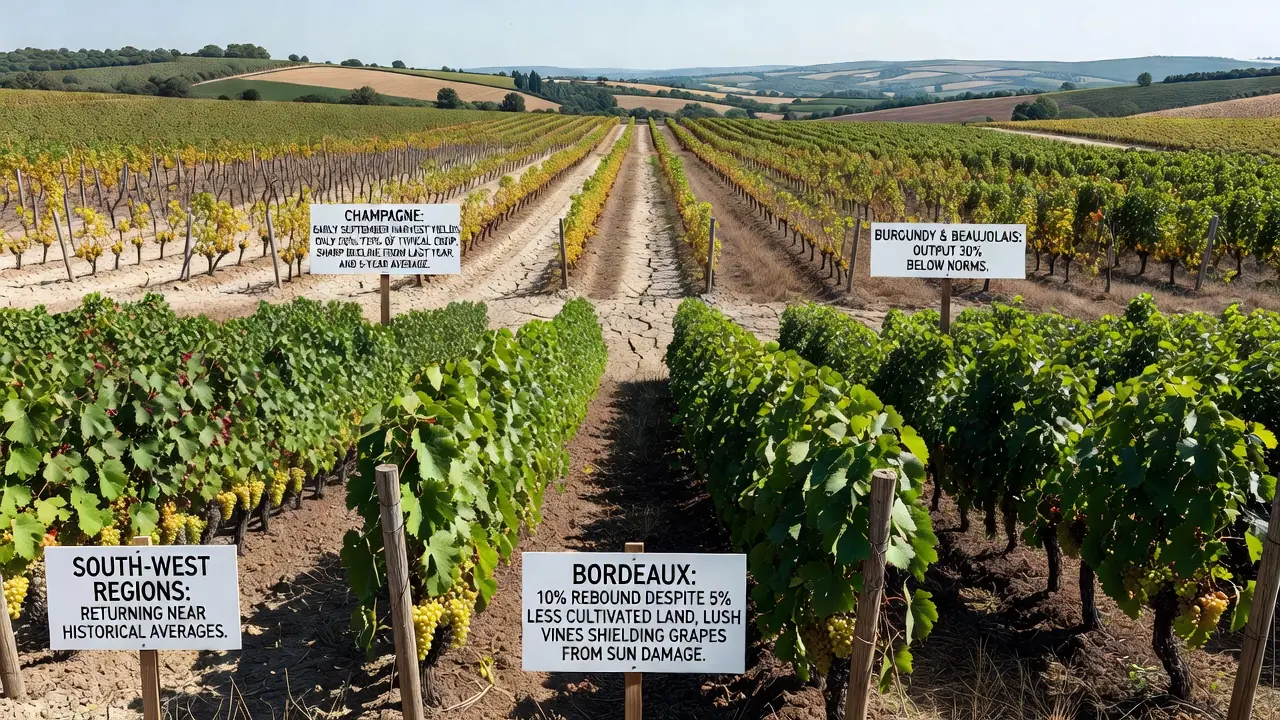
France's vineyards have produced one of the smallest harvests in decades, as repeated summer heatwaves and a shrinking area under cultivation combined to push output well below the recent average. The agriculture ministry estimates this year's total at roughly 35 million hectolitres, 2% below an already weak 2025 and 14% under the 2021-2025 average. The International Organisation of Vine and Wine had already flagged last year's crop as France's smallest since 1957, underlining how persistent the downward trend has become.
Heat, drought and shrinking vineyards
Two forces are driving the decline. The first is climate: a succession of hot spells accelerated sugar accumulation in the grapes, forcing growers to pick earlier than usual to avoid overly alcoholic, unbalanced wine. The second is structural - French vineyard area has contracted by 1.9% over the past year, part of a longer-running adjustment as producers abandon marginal plots amid falling domestic consumption and export pressures. Rain later in the season offered some relief, but not enough to reverse the overall trajectory.
A patchwork of winners and losers
The national figure masks sharp regional divergence. Bordeaux, despite cutting cultivated area by 5%, is expected to see production rise 10% compared with 2025, though it remains 11% below its five-year average. The south-west recorded a similar rebound of around 12%, broadly returning to historical norms. Champagne fared far worse: an early harvest, completed in September for the first time on record, yielded about three-quarters of a typical crop by volume, down roughly half on last year and the five-year average. Burgundy and Beaujolais saw output fall roughly 30% below their five-year norm.
Jérôme Despey, who chairs the wine advisory board at FranceAgriMer, described the variation across regions as unprecedented in his experience. Southern producers, long exposed to extreme heat, have adapted vineyard management - notably by leaving more leaf cover to shield grapes from sun damage - and benefited from timely May rainfall, helping explain why some southern areas outperformed colder northern ones this year.
Quality over quantity, and what it signals
Despite the volume shortfall, both the ministry and industry figures point to strong grape health, with little fungal or moisture-related disease thanks to drier conditions. Claude Mandois, a Champagne producer, noted that while volumes were down, visual and taste quality were exceptional. That trade-off - smaller but cleaner, more concentrated harvests - is becoming a recurring pattern across European wine regions as growers adjust pruning, canopy management and harvest timing to a warming climate.
For an industry built on regional identity and long-term vineyard investment, the implications extend beyond a single vintage. Persistent heat stress raises costs, narrows planting decisions and could reshape which varieties and regions remain commercially viable. Policymakers and producers alike are watching whether this year's heterogeneity - strong in parts of the south, weak in Champagne and Burgundy - becomes the new normal rather than an anomaly.