
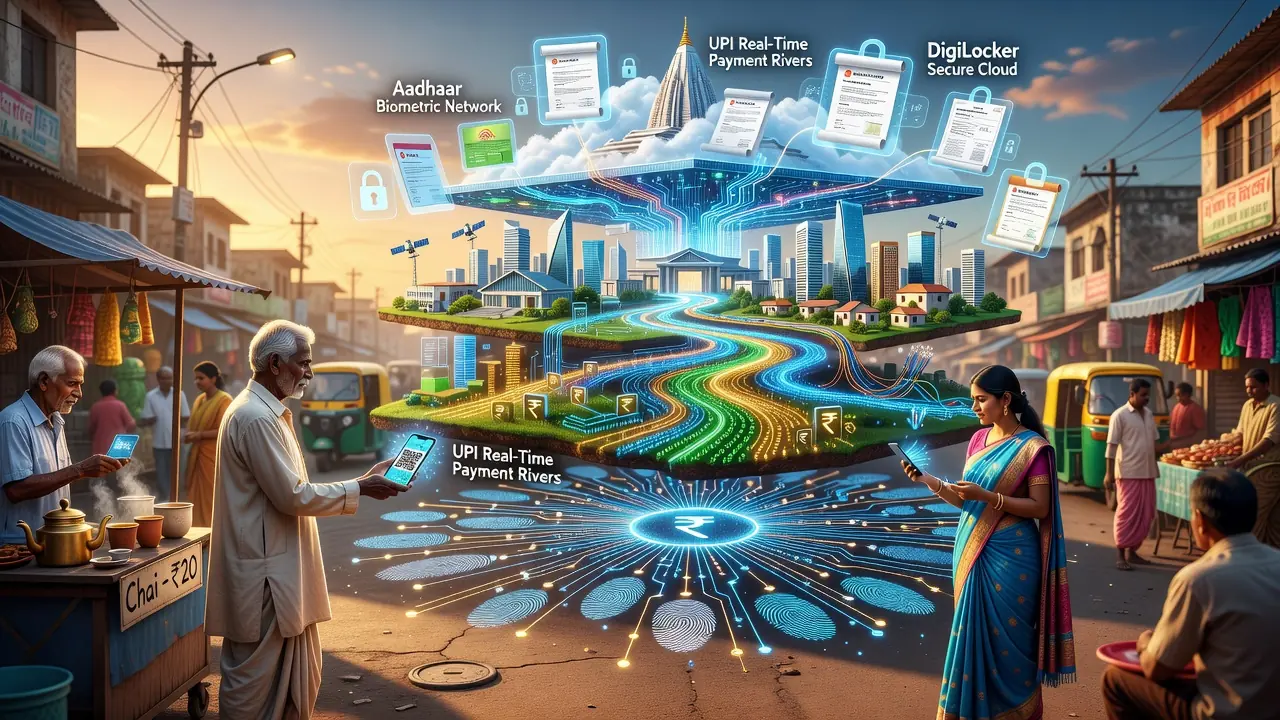
A street vendor accepting twenty rupees for tea through a QR code scan is, in its own small way, proof of concept for one of the most ambitious infrastructure projects of the past two decades. India has spent that time assembling a layered system of digital identity, payments, document storage and public service access that now touches more than a billion people. What makes it notable is not any single application but the way these pieces connect.
Layers Built to Work Together
The architecture rests on a few interlocking components. Aadhaar gave residents a biometric-backed digital identity. UPI turned that identity layer into a payments rail that lets banks, wallets and apps move money instantly without routing through card networks. DigiLocker digitized official documents so licenses, certificates and records could be verified without paper. CoWIN extended the same logic to vaccine scheduling and verification during the pandemic, while DigiYatra applied facial recognition to airport entry, reducing manual document checks. Each system was built separately but designed to interoperate, which is the detail international observers tend to focus on.
This is often described as "Digital Public Infrastructure" - a term now used by multilateral institutions and foreign governments studying the model. The distinction from typical government IT projects is that these are open, interoperable platforms rather than closed systems run by a single vendor. Private banks, fintech startups and public agencies all build on the same rails, which is partly why adoption scaled so quickly.
Why Interoperability Mattered More Than Any Single App
A payments system is only as useful as the number of places that accept it. UPI's design allowed any bank or licensed app to plug into a shared protocol, so a transaction initiated on one app could settle instantly with a merchant using an entirely different one. That removed the walled-garden problem that limits many payment ecosystems elsewhere, where users are often locked into whichever app or card network a merchant happens to support.
The same principle applies across the stack. A document stored in DigiLocker can be verified by a bank, an airline or a government office without the user carrying physical paperwork. An identity verified through Aadhaar can be reused across services instead of each provider building its own verification system from scratch. This reduces duplication of effort and cost, which is a major reason adoption spread across both urban and rural users rather than staying concentrated among smartphone-literate city populations.
What Other Countries Are Actually Studying
Foreign delegations and policy researchers examining India's approach are generally less interested in the technology itself - biometric identity systems and real-time payments exist elsewhere - and more interested in the governance model. Building identity, payments and document infrastructure as public utility layers, open to private innovation on top, is a different approach from either fully state-run systems or fully private ones.
- Shared technical standards that let multiple private players build competing apps on common rails
- Government as infrastructure provider rather than sole service operator
- Rapid rollout across both digital-native and low-connectivity populations
- Reuse of a single verified identity across unrelated services
The Trade-offs Worth Naming
Scale of this kind brings legitimate questions about data protection, surveillance risk and system failure. A single identity layer underpinning banking, travel, healthcare records and government benefits concentrates risk as much as it concentrates convenience - if that layer is compromised or misused, the consequences extend across every service built on it. India has faced public debate over Aadhaar's privacy safeguards, data-sharing rules and the exclusion risk for people without reliable biometric access or connectivity. These are not footnotes; they are central to any honest assessment of the model, and they are the same questions other governments will need to answer before replicating it.