
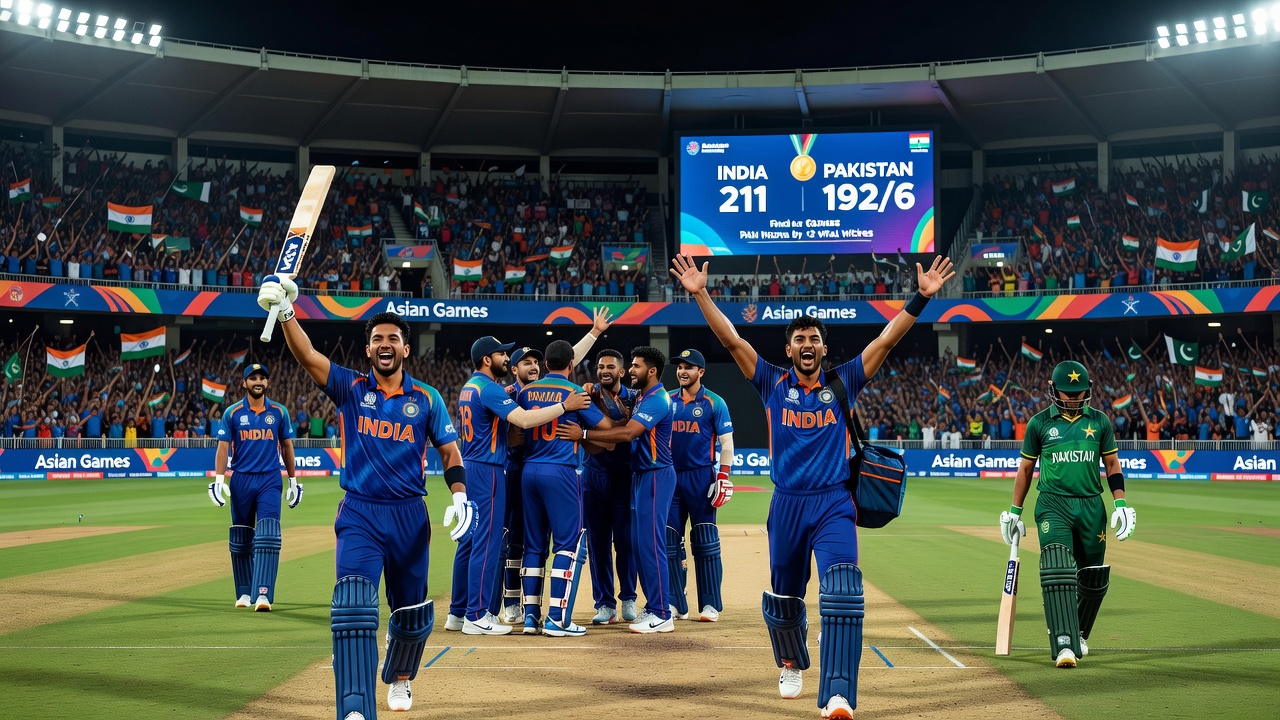
India's men's cricket team defeated Pakistan by 19 runs in the Asian Games final, lifting a second successive gold medal in the discipline and pushing the country's overall gold tally at the Games to 19. The result, delivered in a T20 contest watched closely across both nations, extended a lopsided recent head-to-head record between the two sides in the shortest format of the sport.
How the match unfolded
Batting first, India posted 211 for the loss of wickets in 20 overs, built on half-centuries from Abhishek Sharma, who scored 61, and Tilak Varma, who finished unbeaten on 51. That total put Pakistan under pressure from the outset. In reply, Pakistan reached 192 for six, falling short despite a resolute 96 from Hasan Nawaz, who carried much of the chase on his own. India's bowling attack, led by spinners Axar Patel and Washington Sundar with two wickets apiece, and supported by part-time bowler Shivam Dube's two scalps, proved decisive in containing Pakistan's middle and lower order during the final overs.
A rivalry defined by recent dominance
This win follows India's gold medal in Hangzhou in 2023, making it back-to-back continental titles in the sport. More notably, it reinforces a pattern: India has now won 15 of its last 18 T20 encounters against Pakistan. In a fixture historically framed by political and sporting tension, such a consistent margin of superiority has shifted the narrative from unpredictability to expectation, at least in bilateral T20 contests played on neutral or multi-sport platforms like the Asian Games.
Why this result resonates beyond the scoreboard
Cricket between India and Pakistan carries weight far beyond a single trophy. Matches between the two draw enormous television and streaming audiences, and that attention inevitably extends into commercial activity surrounding the sport, including sponsorship, broadcasting rights, and fan engagement platforms. High-profile fixtures of this kind also tend to see a spike in public interest around sports betting markets in regions where such activity is legal or loosely regulated, even though neither country's cricket boards endorse or promote wagering on matches.
That underlying interest is worth acknowledging without amplifying it. Major India-Pakistan contests are frequently cited by consumer-protection advocates as moments of heightened risk for impulsive betting behavior, given the emotional intensity fans attach to the rivalry. Regulators in markets where betting is legal generally recommend that operators apply extra scrutiny to marketing and promotional activity timed around marquee fixtures, since emotionally charged events can cloud judgment around spending limits.
What the result means going forward
For Indian cricket, successive Asian Games golds add to an already crowded list of achievements in white-ball formats, reinforcing the team's depth beyond its senior international lineup, since many Asian Games squads feature a mix of established and emerging players. For Pakistan, Hasan Nawaz's performance offers a clear positive despite the loss, suggesting room for optimism even amid a difficult recent record against their closest rival. Beyond the result itself, the fixture is a reminder of how deeply sport, national identity, and commercial interest intersect whenever these two teams meet - a dynamic that extends well past the boundary rope.