
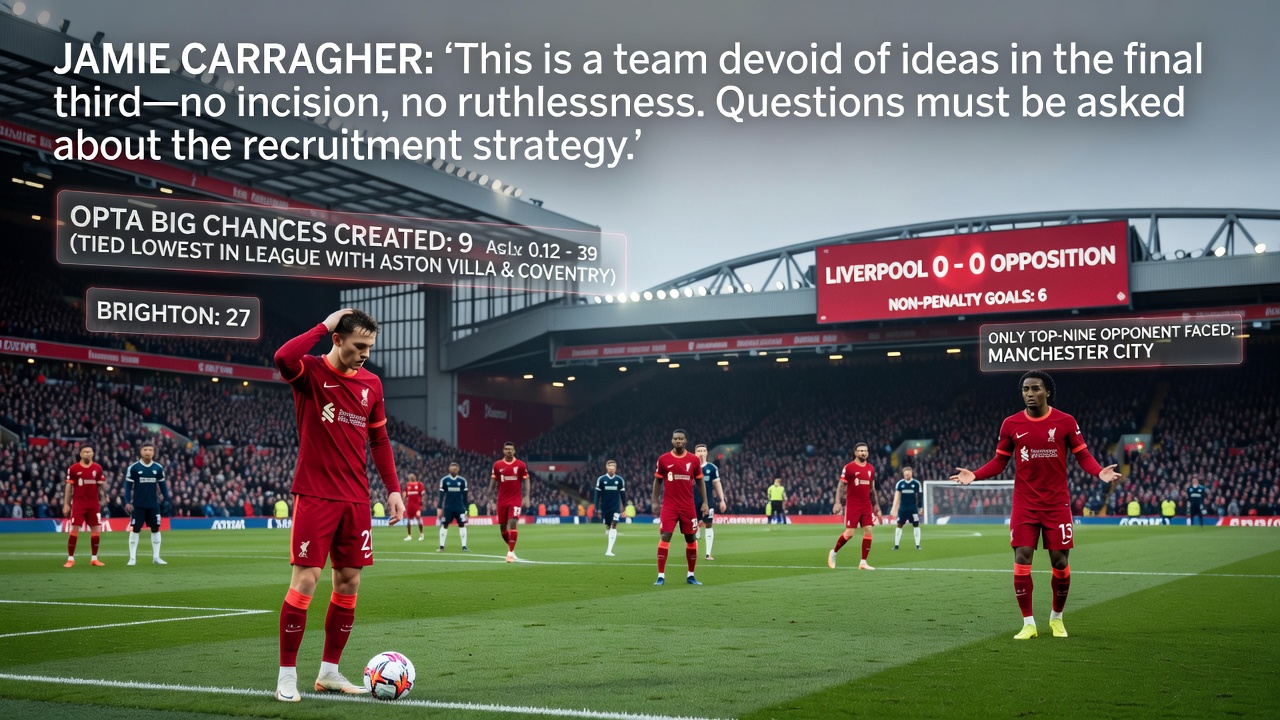
Six non-penalty Premier League goals in the opening stretch of a season is a number that belongs to a relegation candidate, not a club that spent heavily to build an attack around Andoni Iraola's high-tempo principles. Liverpool sit among the lowest scorers in the division, and the underlying data suggests this is not a blip but a structural problem. For anyone watching the goals markets around Liverpool fixtures, the gap between reputation and output has become difficult to ignore.
Chance creation tells the real story
Goals can be streaky, but chance creation is a steadier indicator of attacking health. Liverpool have produced only nine Opta-defined big chances this season, tied for the lowest in the league alongside Aston Villa and Coventry. Brighton, by comparison, have created 27. That gap is not noise. It reflects a team struggling to generate clear-cut opportunities, regardless of who finishes them. Iraola's football is built on quick transitions and disorienting pressing triggers, but none of that matters if the final product does not arrive in the shape of real chances.
Schedule strength adds further weight to the concern. Manchester City remain the only top-nine Premier League side Liverpool have faced so far. A struggling attack against a soft run of fixtures is a harder problem to explain away than one shaped by a brutal schedule.
Wirtz and the weight of expectation
Florian Wirtz arrived as a marquee signing, and marquee signings carry scrutiny that ordinary squad additions do not. Jamie Carragher's assessment - that he struggles to recall a single game Wirtz has won for Liverpool - reflects a broader statistical pattern rather than an isolated opinion. Across 39 Premier League appearances since his move, Wirtz has averaged 0.16 assists and 0.12 goals per game, a combined involvement rate that 88 players with at least 20 appearances in that window have bettered. His output currently mirrors that of Jurrien Timber, a full-back, which is a jarring comparison for a player signed to operate as a creative focal point.
Bradley Barcola's early struggles following his own costly transfer add to the picture, though it remains premature to draw firm conclusions from a small sample. The more pressing issue is systemic: movement, link-up play and composure in the final third have all looked underdeveloped collectively, not just individually.
What this means for goals markets
Markets built around pre-season reputation tend to move slowly. Liverpool's name, and the attacking identity associated with Iraola, can keep goal-related prices higher than current form justifies. That lag creates a window for bettors paying closer attention to underlying numbers rather than brand expectation - though it is worth stressing that this reflects a pattern in current form, not a certainty about future results. Liverpool's price of 10/11 (1.91) for under 2.5 goals in their Champions League visit to LASK sits within that context: a team whose output has consistently fallen short of its billing, priced by a market that has not yet fully adjusted.
None of this guarantees Liverpool's struggles continue. Squads can recalibrate quickly once combinations click, and elite talent rarely stays dormant for long. But until chance creation and finishing improve together, treating Liverpool as a reliably high-scoring side looks like backing an assumption rather than the evidence in front of it.