
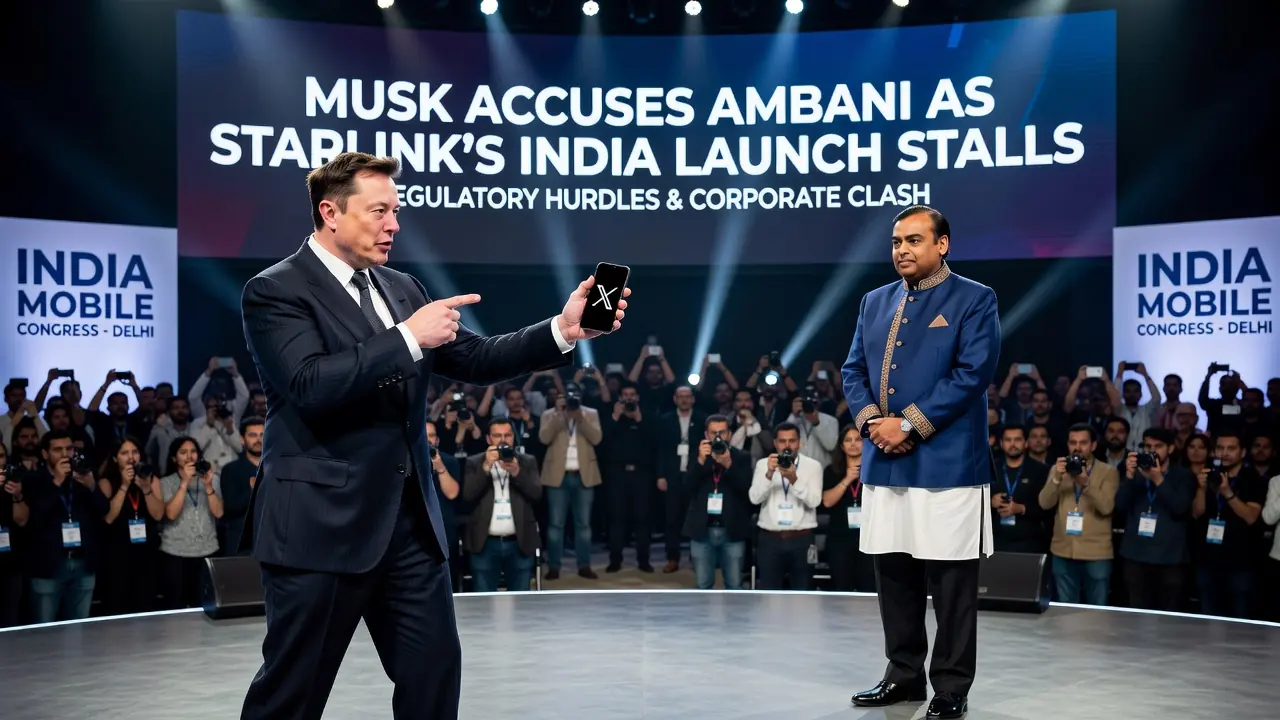
Elon Musk has publicly questioned whether Mukesh Ambani, India's richest man, holds more sway over the country's telecoms policy than its government does. The remark, posted on X, followed a day of accusations from Musk that unnamed "oligarchs" were blocking Starlink's entry into India through a "monopolistic chokehold" on consumers. India's Ministry of Communications has rejected the claim, insisting its licensing framework applies equally to all applicants.
A Dispute Rooted in Regulatory Timing
At the centre of the row is a licensing process that has dragged on for years. Starlink, owned by Musk's SpaceX, has pursued approval to operate in India since 2021 and has cleared several regulatory hurdles. What remains outstanding are security clearances and spectrum allocation - the final steps before any satellite internet operator can launch commercial services in the country. According to India's telecoms ministry, Starlink is not being singled out: Eutelsat OneWeb and Jio Satellite Communications, a Reliance subsidiary, are reportedly at a similar stage, awaiting the same approvals.
That detail complicates Musk's framing of the dispute as a deliberate obstruction orchestrated by rival business interests. If Jio's own satellite arm is subject to the identical bottleneck, the delay looks less like favoritism and more like the structural slowness common to spectrum allocation in large, security-conscious markets. India has repeatedly cited national security as a rationale for cautious vetting of satellite communications providers, a concern sharpened by incidents in 2024 in which Starlink equipment was recovered during a drug-smuggling investigation and a military operation, despite Musk's insistence that the network was never active in the country.
Competitors and Partners in the Same Breath
The dispute is unusual because Starlink is not purely a rival to Reliance Jio and Bharti Airtel - it is also their prospective partner. In March 2025, both Indian telecom giants signed distribution agreements with SpaceX, conditional on regulatory approval, and raised the possibility of sharing network infrastructure. That arrangement means Musk is simultaneously negotiating commercial cooperation with the very companies he suggests may be working to keep him out of the market. Executives from all three firms appeared together at the India Mobile Congress in Delhi this week, where Reliance Jio's Akash Ambani declined to respond directly to Musk's allegations, saying the company preferred to focus on serving Indian consumers.
What Is Actually at Stake for Indian Consumers
Beyond the corporate sparring, the practical question is whether satellite internet will be affordable for the rural and underserved populations it is meant to reach. India has some of the world's largest internet usage numbers, but access remains patchy outside urban centres, where laying fibre or extending mobile towers is costly. Satellite broadband, beamed directly from low Earth orbit, bypasses that infrastructure gap in theory.
Whether it does so in practice depends on pricing that has not yet been disclosed for the Indian market. Starlink's residential plans in the United States start at $55 a month before equipment costs - a price point analysts say would be out of reach for a large share of Indian households without substantial local adaptation. That affordability question, separate from the political theatre around Ambani and Musk, will ultimately determine whether satellite internet closes India's connectivity divide or remains a premium product for a narrow segment of users.
A Test Case for Platform Power and Regulatory Trust
The episode illustrates a recurring tension in digital infrastructure markets: when a foreign platform operator publicly challenges a government's regulatory process, it risks framing legitimate bureaucratic caution as protectionism, while genuine conflicts of interest between domestic incumbents and regulators can go unexamined. India's insistence that its rules are "fair and non-discriminatory" will likely be tested by how quickly Starlink, OneWeb and Jio's satellite unit actually receive their clearances. Consumers, meanwhile, are left watching a dispute between billionaires that will shape what their internet access looks like - and costs - for years to come.