
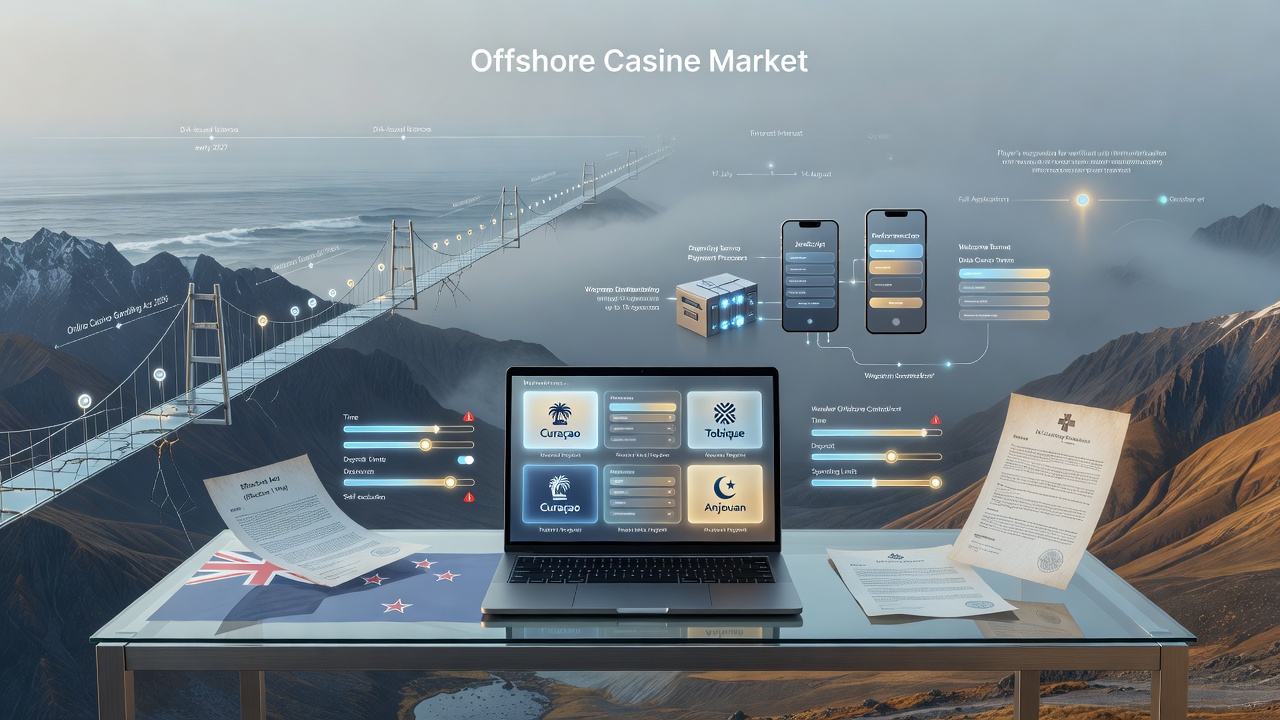
New Zealand players researching online casinos in 2026 are navigating a market in transition, not a settled one. The Online Casino Gambling Act 2026 took effect on 1 May, creating a path toward a licensed domestic market overseen by the Department of Internal Affairs, but no licences have been issued yet. Until early 2027, every casino accepting Kiwi players operates under offshore authorisation, and that gap between policy intent and practical reality is exactly where buyers need to pay attention.
Why the Transition Period Matters
Under the new framework, up to 15 operators will eventually hold DIA-issued licences. Expressions of interest opened on 17 July 2026 and closed on 14 August, with a competitive auction expected in September and full applications from October. That timeline means the first licensed operators are unlikely to go live before early 2027. In the meantime, the Act permits existing offshore operators to continue serving New Zealand players under transitional arrangements running until 1 December 2026. This is a deliberate bridge, not a loophole, but it does mean consumer protections during this window rest on whatever offshore licence a given operator holds, rather than on the harm-minimisation standards the new Act will eventually mandate.
What Offshore Licensing Actually Covers
Curaçao, Tobique, and Anjouan licences are the three jurisdictions currently represented among operators serving the NZ market. These frameworks establish baseline oversight - verifying that an operator is a registered legal entity and subject to some form of ongoing supervision - but they are not equivalent to stricter regimes such as the UK Gambling Commission or the Malta Gaming Authority, which impose more detailed requirements around dispute resolution, financial segregation, and responsible-gambling tooling. A citable licence number, such as those some operators display and that can be cross-referenced against a regulator's public register, is a meaningfully stronger signal than a generic claim of being "licensed offshore." Players should treat licence verification as a first step, not a formality.
What Will Change Once NZ Licensing Is Live
The Act's most consequential requirement is mandatory harm-minimisation infrastructure: licensed operators will have to give players tools to set time, deposit, and spending limits, alongside self-exclusion options. These features are common among better-regulated offshore operators already, but they will become compulsory rather than optional once the domestic licensing regime is operational. This shift mirrors a broader pattern seen in other markets - Great Britain, several EU states, and parts of Australia - where regulators have moved from reactive enforcement toward requiring affirmative player-protection design built into the product itself.
What Players Should Check Before Depositing
Game variety, payment flexibility, and bonus terms vary widely across the operators currently active in this market, and none of that is a substitute for licensing diligence. Practical checks include:
- Confirming the licence number is active on the issuing jurisdiction's public register, not just displayed on the casino's own site
- Reading the full wagering and withdrawal terms attached to any welcome bonus, since headline figures rarely reflect the real cost of unlocking funds
- Checking which entity actually processes payments - some card transactions run through third-party processing companies rather than the casino brand itself
- Reviewing site performance on mobile data connections, since heavier, JavaScript-dependent platforms can behave inconsistently outside strong broadband
Once New Zealand's own licensing regime is fully operational, the market should offer clearer accountability and more consistent consumer safeguards. Until then, the responsibility for vetting an operator sits largely with the player, and that distinction is the single most important thing to understand about the current state of online casino gambling in New Zealand.