
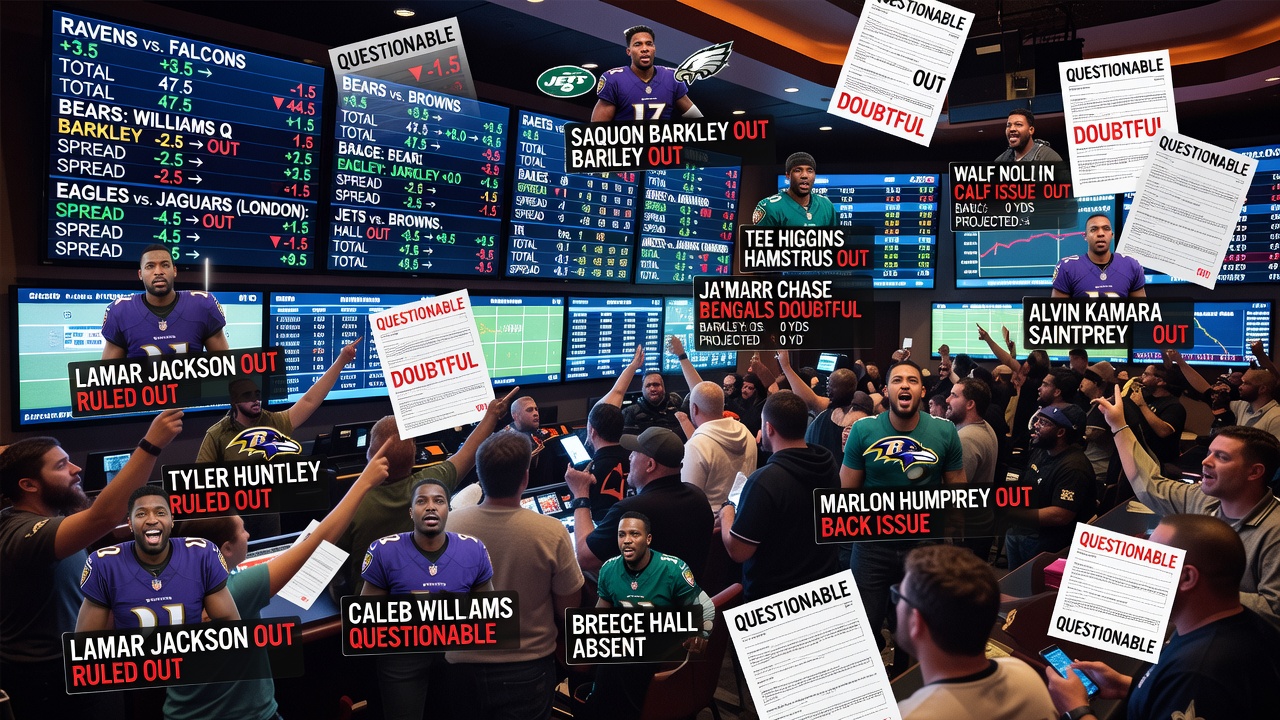
Sunday's Week 5 slate carries an unusually heavy injury load, with several starting quarterbacks and marquee skill players sidelined or questionable just hours before kickoff. Lamar Jackson will not play for Baltimore against Atlanta, Caleb Williams remains questionable in Chicago, and Saquon Barkley has been ruled out for Philadelphia's London matchup with Jacksonville. For sportsbooks and bettors alike, this kind of late-breaking medical news is one of the most consequential variables in setting and moving lines.
Why Injury News Moves the Market
Point spreads and totals are built around expected performance, and that expectation collapses quickly when a starting quarterback or lead back is removed from the equation. Jackson's absence hands the start to Tyler Huntley, a change that typically triggers immediate line movement because backup quarterbacks carry different statistical profiles than the players they replace. Similarly, Barkley's exclusion in Philadelphia and Breece Hall's absence for the Jets against Cleveland directly affect rushing and scoring projections that oddsmakers rely on. Sportsbooks adjust in real time, and the gap between a line set Wednesday and the number available at kickoff can be significant once final injury designations are confirmed.
The Role of the Official Injury Report
The NFL's injury reporting system exists partly for competitive integrity and partly to protect the information ecosystem that betting markets depend on. Teams are required to disclose player status under set categories - out, doubtful, questionable - and designations can shift right up until the Friday report, as seen with players like Ja'Marr Chase and Tee Higgins, both officially questionable despite full practice participation. This structured disclosure reduces the chance that selective or delayed information gives any single party an unfair edge, a principle regulators and leagues both treat as central to legitimate sports wagering markets.
What This Means for Consumers
For anyone following these markets, the lesson is less about finding an edge and more about understanding volatility. Lines tied to uncertain injury statuses - Walter Nolen's calf issue in Arizona, Marlon Humphrey's hamstring in Baltimore, or Alvin Kamara's back in New Orleans - can swing meaningfully between the final practice report and game time. That volatility is a normal feature of a transparent market, not a flaw to exploit. Bettors should treat injury news as public, time-sensitive information rather than a guaranteed predictor of outcomes, since player availability is only one of many factors influencing results on the field.
A Broader Pattern in Roster Management
Beyond the betting implications, this week's reports also reflect how teams manage long-term player health against short-term competitive pressure. Decisions to place players like Pat Bryant and Rashawn Slater on injured reserve, rather than rushing them back, show franchises increasingly prioritizing recovery timelines over single-game availability. That trend has quietly reshaped how analysts and bettors read injury reports - not just as a game-day checklist, but as a signal of a team's broader health strategy across a 17-game season.