
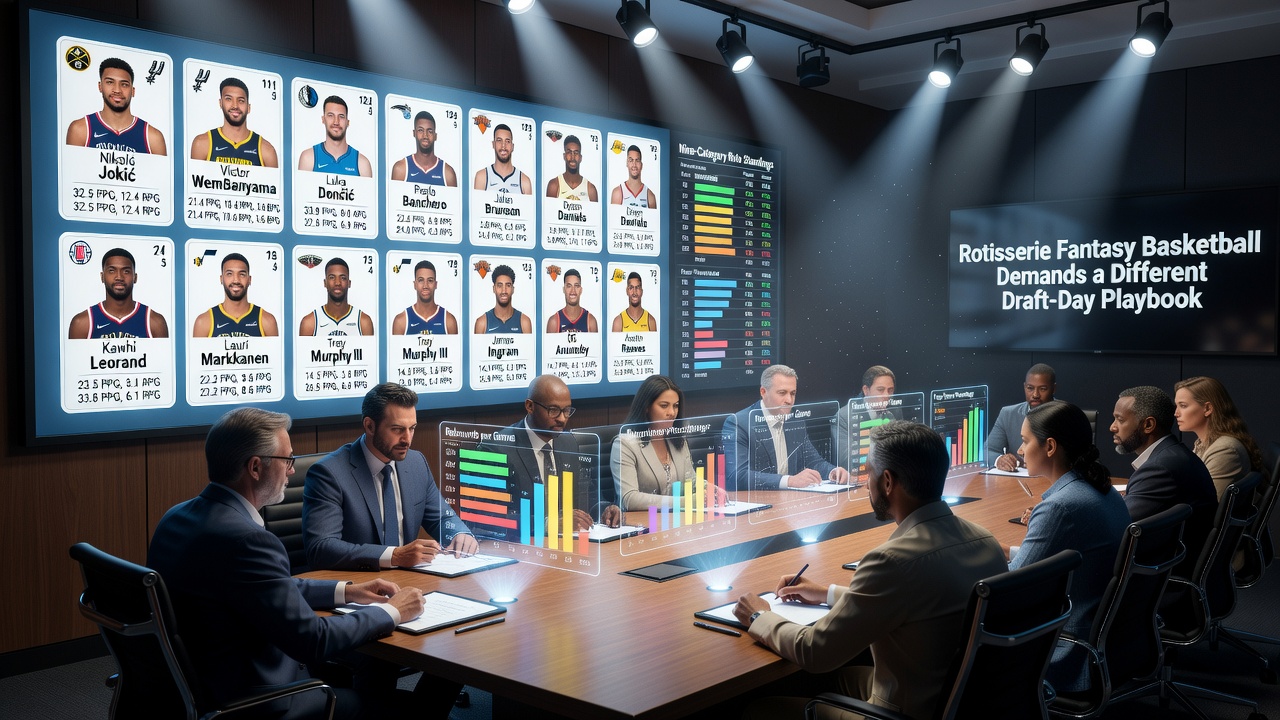
Fantasy basketball's rotisserie format rewards patience and punishes early stumbles differently than head-to-head leagues do, which changes how managers should approach the draft from pick one. A recent 12-team, nine-category roto mock draft, run by Rotoworld's Raphielle Johnson from the first overall slot, illustrates how that format shapes roster-building decisions in ways that ripple through every subsequent round.
Why the Format Changes the Math
In head-to-head leagues, a bad week can be shrugged off; the next matchup offers a clean slate. Rotisserie scoring accumulates across the entire season, so early mistakes compound. That structural difference pushes some managers toward higher-variance picks later in drafts, since there's more time to recover through trades or waiver-wire activity. But it also raises the stakes of the opening picks, where the goal is establishing a stable foundation rather than chasing upside.
This is why the choice between Nikola Jokić and Victor Wembanyama at pick one matters so much. Jokić's appeal lies in consistency: he's led the league in rebounds and assists, and his MVP-caliber production across multiple statistical categories makes him a lower-variance anchor. Wembanyama offers a different kind of value - the ability to single-handedly dominate the blocks category - but with less of a multi-year track record at the highest level. Neither choice is wrong; they simply optimize for different risk profiles, which is a recurring theme throughout roto drafting.
Category Balance Over Raw Talent
One of the more instructive patterns in this mock draft is how certain player profiles get valued differently in categories leagues than in points-based formats. Luka Dončić, for instance, becomes more attractive in roto because turnovers are just one of nine categories rather than a heavily weighted drag on a single point total. Similarly, Paolo Banchero's shaky percentages and turnover rate are more tolerable when paired with efficient teammates like Jokić or Jalen Brunson, who can offset those weaknesses elsewhere on the roster.
This kind of category-stacking is a core mechanic of roto strategy: managers aren't just drafting the best available player, they're drafting pieces that fit together statistically. A player with elite scoring but poor free-throw shooting, like Dyson Daniels, needs to be balanced against teammates who shoot well from the line, or that category becomes a lost cause for the entire season.
Injury Risk and the Availability Discount
Health remains the single biggest variable fantasy managers can't fully control. Players like Kawhi Leonard, Lauri Markkanen, and Trey Murphy carried injury question marks into this draft, and their draft positions reflected a market attempting to price in that uncertainty. The James Ingram situation - a partially torn Achilles discovered during offseason surgery - raises a tougher question for managers: is it worth spending a mid-round pick on a player whose availability is genuinely uncertain, or is a late-round flier on a healthier, lower-ceiling option the more disciplined play?
There's no universally correct answer, but the exercise highlights something true of fantasy sports generally: outcomes are probabilistic, not guaranteed, and managers who treat draft picks as forecasts rather than certainties tend to build more resilient rosters.
What This Means for Casual and Serious Players Alike
Mock drafts like this one serve a practical function beyond entertainment - they help managers calibrate average draft position (ADP) against actual risk tolerance before real drafts begin. Players such as OG Anunoby or Austin Reaves, who may be undervalued relative to their contribution, often become the difference between a competitive roster and a mediocre one. The broader lesson for anyone engaging with fantasy sports, paid or otherwise, is that informed, data-driven decision-making consistently outperforms reactive, hype-driven drafting, even though no amount of preparation eliminates the uncertainty inherent in professional sports.