
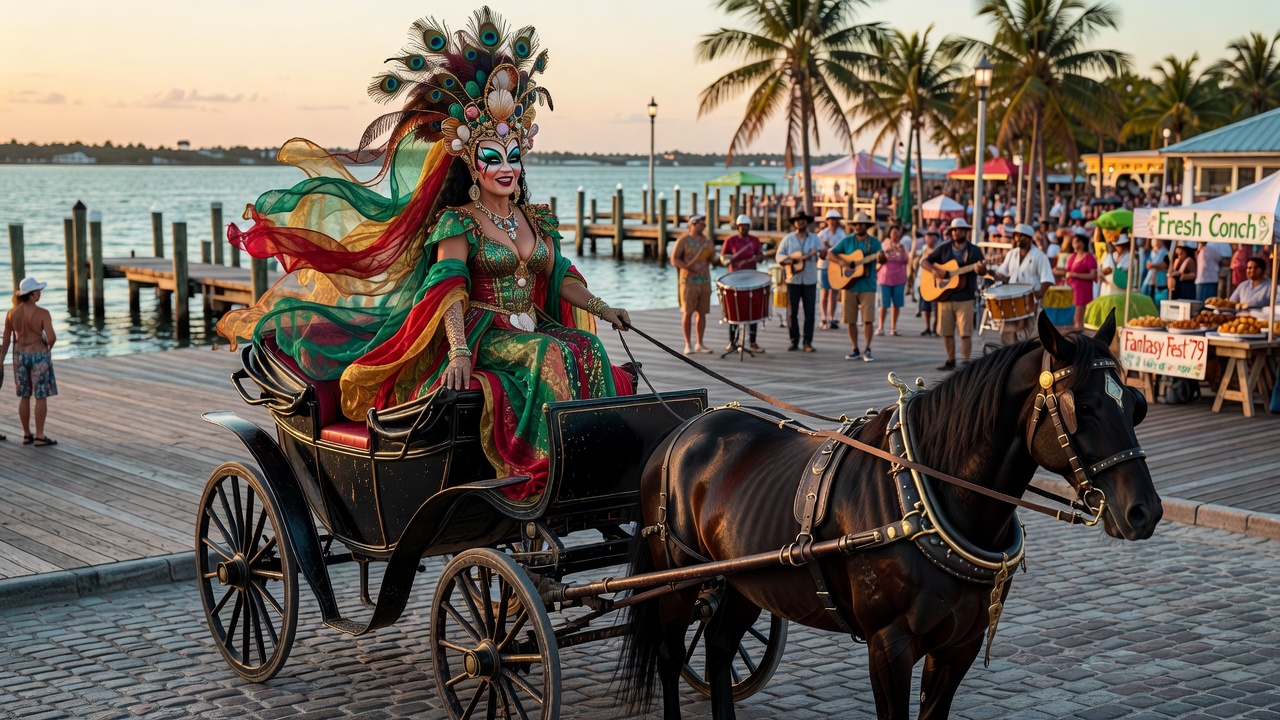
A black horse-drawn carriage carried Mary Ellen Toppino into Mallory Square on October 26, 1979, and with that arrival, Key West's Fantasy Fest was born. The three-day celebration blended calypso music, island food, and theatrical costume into a tradition that has since grown into one of the most recognizable autumn events in the Florida Keys. Four decades later, the hunt for a single authentic photograph from that opening night has become its own small research project, one that says a lot about how local history survives, and how it sometimes nearly doesn't.
Why One Photograph Matters
A newspaper column reconstructing a 1979 event depends on primary visual evidence, not approximation. The image currently in hand, a horse-and-buggy tour operating on Whitehead Street that same year and documented in a December 1979 Miami Herald article, is useful context but not confirmation. It shows the kind of carriage that existed in Key West at the time. It does not show the Grand Mistress of Madness on her actual ride into Mallory Square. That distinction matters to anyone committed to accurate local journalism, where the gap between "plausible" and "verified" is the difference between illustration and documentation.
The Fragility of Community Archives
Much of what survives from early Fantasy Fest exists not in a formal museum catalog but in private shoeboxes, family albums, and the memories of residents who were there. The Wright Langley Collection at the Florida Keys History Center, housed within the Monroe County Public Library, represents the kind of institutional effort that keeps this material from disappearing entirely. But institutional archives can only hold what someone thought to donate. Photographs from a three-day street festival in 1979, taken on personal cameras and never submitted for publication, are exactly the kind of material that tends to stay in private hands or get lost in moves, estate cleanouts, and water damage.
This is a pattern familiar to local historians everywhere: the first years of an event are often the least documented, precisely because nobody involved yet understands how significant the event will become. Fantasy Fest in 1979 was a modest, community-organized gathering. Nobody was thinking about an archive.
Why Crowdsourcing Still Works
Public appeals for old photographs, run through a local paper, remain one of the more reliable ways to recover material that never made it into formal collections. A few considerations make this kind of search more productive:
- Family photo collections often go undigitized for decades, meaning a direct public request can surface images no archive would ever find on its own.
- Context matters as much as the image itself. A photograph without a date, name, or location loses most of its documentary value.
- Local libraries and historical societies, like the Florida Keys History Center, are typically willing to accept copies or scans even when the original stays with the family.
The effort to find one accurate image is a reminder that local journalism and community archiving depend on the same thing: people willing to check their boxes before a story runs, and willing to share what they find.